In this way, the lithospheric plates are constantly shifting position on the surface of the globe, despite their rigidity, and as they are carrying continents with them, such continents are also constantly drifting away or towards each other.
As an oceanic lithospheric plate is forced under another oceanic or continental plate and its descending part starts to melt, viscous magmas are intruded and squeezed between the colliding plates, while lighter and more fluid ones are extruded at the opposite edge to form island-arcs. These eventually grow into subcontinents and continents, are plastered to the margins of nearby continents, or squeezed between two colliding continents.

Plate Movements: Divergence, Convergence, and Sliding

Such divergence, convergence and sliding of lithospheric plates are not confined to ocean basins, but are also found along the margins, as well as within and in between continents.
Both the Red Sea and the Gulf of California troughs (which are extensions of oceanic rifts) are currently widening at the rates of 3cm/year and 6cm/year respectively.
On the other hand, the collision of the Indian Plate with the Eurasian Plate, after the consumption of the oceanic plate that was separating them, resulted in the formation of the Himalayan Chain, with the highest peaks on the surface of the Earth today.
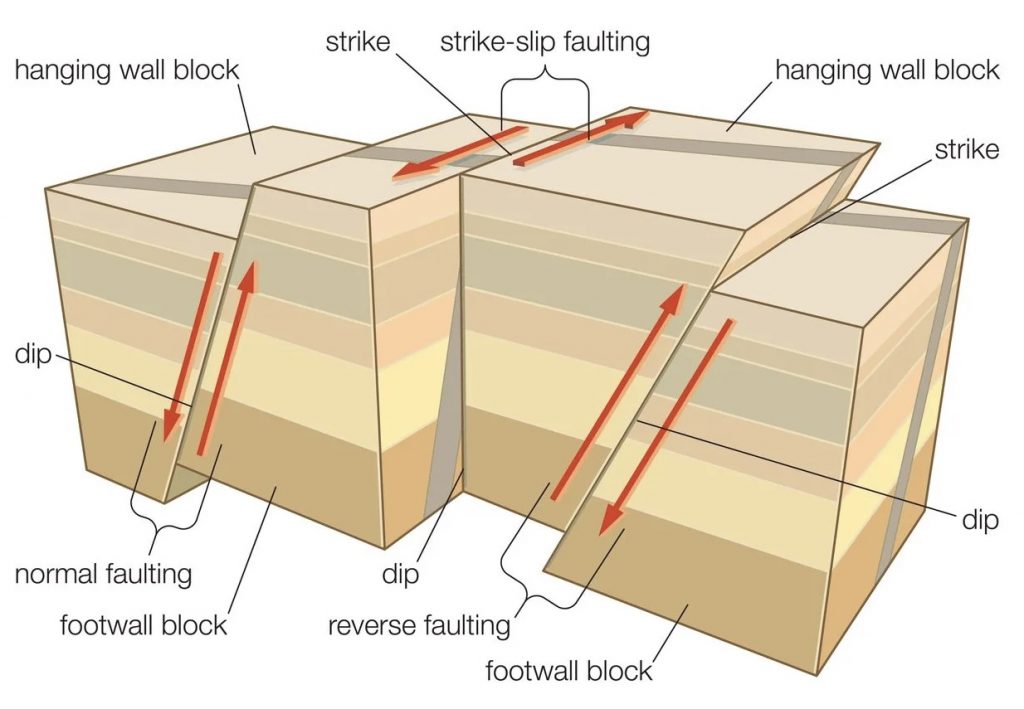
Fault planes traversing the outer rocky sphere of the Earth for tens of thousands of kilometers across the globe, running in all directions for a depth of 65-150 km are among the most salient features of our planet.
These came to human notice only after the Second World War and were only understood within the framework of the concept of plate tectonics which was finally formulated in the late sixties and the early seventies of this century (cf. Hess, 1963; Morely, 1963; Wilson, 1965; McKenzie, 1967; Maxwell and others, 1970; Cox, 1973; Le Pichon and others, 1973; Dennis and Atwater, 1974, etc.).
The Role of Fault Systems in Earth’s Evolution
These lithospheric faults are a globe-encircling system of prominent rift zones (65-150 km deep and tens of thousands km long) along which lithospheric plates are displaced with respect to one another divergently, convergently or sliding past each other. They are also passageways through which the trapped heat below the lithosphere is steadily released, and different magmas are steadily outpouring.
Molten magmas in numerous hot spots, deep in the mantle, being less dense, tend to rise up and descend down on cooling in the form of hot plumes that create convection currents. Such currents carry the lithospheric plates and move them across the globe, with divergent, convergent, and sliding relationships.
Divergence takes place at the rising tips of the convection current, while convergence takes place at its descending sides.
During the early history of the Earth, its interior was much hotter (due to the greater amount of residual heat of accumulation and the much greater amounts of radioactive isotopes such as 235U and 40K) and hence convection was much faster and so were all the phenomena associated with it {such as volcanic activity, earthquakes, plate movements, mountain-building movements and continental build-ups, (or the so-called ocean-continent cycle or the geosynclinal/mountain-building cycle), etc.}.
During these processes, both the atmosphere and the hydrosphere of the Earth were outgassed, the continents were constructed as positive areas above the ocean basin (through the accretion of volcanic island arcs into sub-continents and continents) and mountains were built.
Faults as Passageways for Earth’s Energy

About 500 million years ago the early continents were dispersed across the surface of the Earth, in positions much different from the ones occupied by the continents of today.
Convection currents then operating in the mantle ended up pushing all the early continents together around 200 million years ago, into a single super-continent (Pangea) above a single super-ocean (Panthalassa).
The outer rocky sphere of the Earth (or lithosphere) acted as a lid, impeding heat flow from inside the Earth. The trapped heat produced a great rift system right in the middle of the mother continent, and this rift system propagated gradually though time, separating North America from North Africa (about 180 million years ago) and from Europe (about 150 million years ago), followed by separating South America from Africa (about 110 million years ago) and separating Greenland from Norway (about 65 million years ago), when Iceland began forming.
Click to read more…
Pages: 1 2 3